


 中文简体
中文简体 Español
 日本語
日本語 0
0
Why Microfiber and Digital Printing Are Driving the Sports Towel Market Forward?
Content
- 1 Material Revolution: How Microfiber Is Redefining Sports Towel Performance Standards
- 2 Cooling Technology: The Physics Behind Cooling Sports Towels and Their Applications
- 3 Application Scenarios: Diversified Commercial Paths for Sports Towels
- 4 Print Customization: How Digital Technology Empowers Sports Towel Brand Differentiation
- 5 Procurement Guide: Key Points for Selecting Outdoor Sports Towels and Evaluating Suppliers
- 6 Industry Trends: Intelligence and Sustainability Driving in Tandem
Sports towels have evolved from simple functional sweat-wiping tools into exercise companions integrating temperature regulation, antimicrobial protection, and brand communication. Industry data shows that the global sports towel market reached USD 4.2 billion in 2024, with a projected CAGR of 6.8% through 2028. Microfiber material, with its 40% faster drying speed and weight at only one-third of traditional cotton, has become the preferred substrate for outdoor sports towels. Meanwhile, digital printing customization technology has transformed sports towels into high-repurchase-rate vehicles for event support and brand marketing.
Material Revolution: How Microfiber Is Redefining Sports Towel Performance Standards
While traditional cotton sports towels offer excellent absorbency, they suffer from slow drying, heavy weight, and bacterial growth issues. The breakthrough in microfiber technology fundamentally resolves these pain points and is rapidly replacing cotton as the mainstream material for sports towels.
Performance Comparison: Microfiber vs. Cotton Sports Towels
| Dimension | Microfiber | Pure Cotton |
|---|---|---|
| Drying Speed | 40-50% Faster | Slower |
| Weight (Same Size) | 60-70% Lighter | Heavier |
| Absorbency Ratio | 7-8x Self Weight | 5-6x Self Weight |
| Antimicrobial | Silver Ion Embedded | Weak Natural Defense |
| Portability | Palm-Sized Foldable | Bulky |
| Durability (Washes) | 300+ Cycles | 150-200 Cycles |
The core advantage of microfiber lies in its ultra-fine denier fibers (single filament fineness ≤1 denier). This structure provides a specific surface area over 40 times that of ordinary fibers, enabling faster moisture wicking and evaporative cooling. For long-duration outdoor activities such as marathons and trail running, a microfiber sports towel can fully dry within 30 minutes after soaking, whereas cotton towels require 2-3 hours under the same conditions.
Cooling Technology: The Physics Behind Cooling Sports Towels and Their Applications
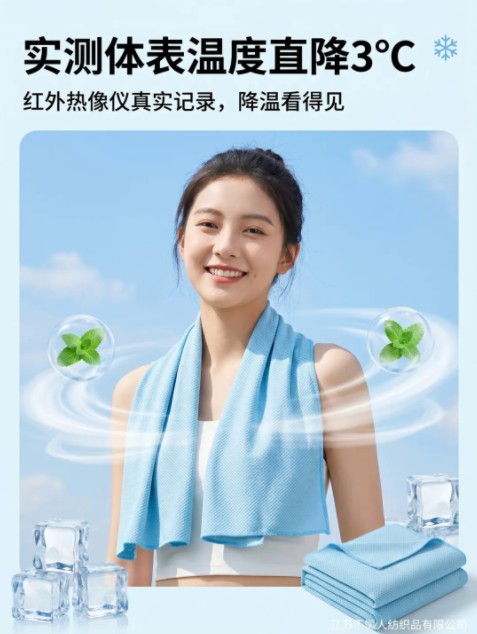
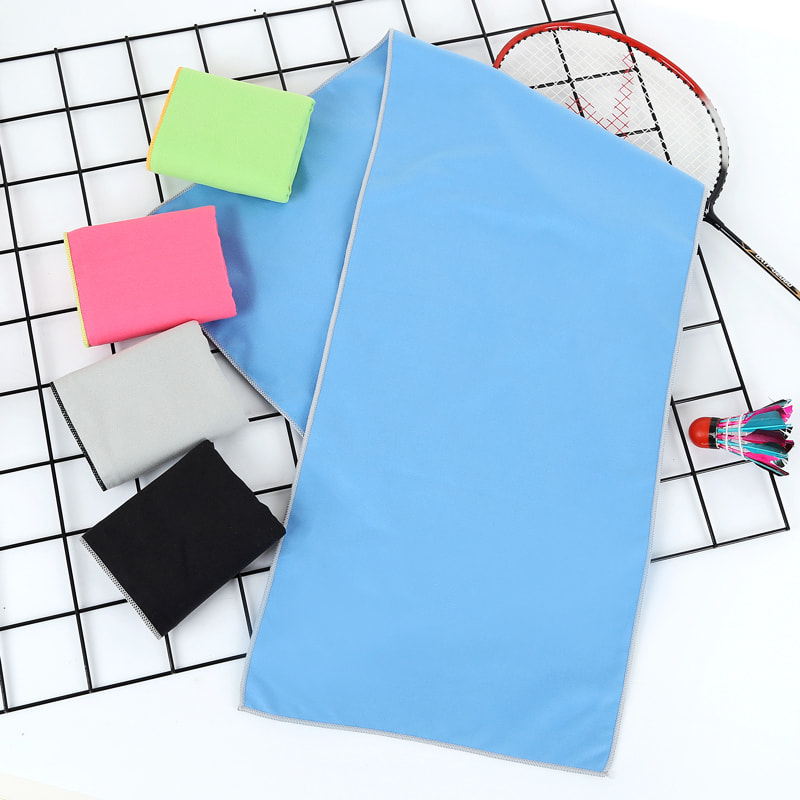
Cooling sports towels represent the fastest-growing subcategory in recent years. Their core principle relies not on chemical cooling agents but on physical evaporative heat dissipation. Through specially engineered irregular cross-section fiber structures, moisture is rapidly dispersed across the fabric surface, accelerating evaporation and removing body heat.
Key Technical Indicators for Cooling Sports Towels
- Contact Coolness Value (Q-max): The core metric measuring instant fabric coolness. Premium cooling sports towels should achieve Q-max ≥ 0.25 W/cm², with high-end products reaching 0.35+. Higher values indicate more pronounced skin contact coolness.
- Temperature Reduction: Infrared thermal imaging tests confirm that quality cooling sports towels can lower skin surface temperature by 2-3°C, with particularly significant effects in high-temperature environments.
- Fiber Cross-Section Structure: Ultra-fine fibers with cross-shaped, Y-shaped, or hollow irregular cross-sections deliver stronger capillary effects, increasing moisture dispersion speed by 50%+.
- Breathable Mesh Structure: Four-way stretch breathable mesh design accelerates air circulation, extending cooling duration by 30-40%.
Using a cooling sports towel is remarkably simple: soak, wring, and snap—three steps activate the cooling effect. In summer outdoor scenarios such as football leagues and marathon events, cooling sports towels have become standard equipment for both spectators and athletes, with single-event merchandise sales reaching thousands of units.
Application Scenarios: Diversified Commercial Paths for Sports Towels
Sports towels have evolved from single-purpose sweat-wiping tools into diversified commercial vehicles covering event support, corporate marketing, fitness consumption, and outdoor adventure. Different scenarios impose differentiated requirements on functional focus, dimensions, and pattern styles.
Major Application Scenarios and Demand Characteristics
| Scenario | Typical Size | Core Function Focus | Pattern/Design Features |
|---|---|---|---|
| Gym / Yoga Studio | 40×80cm | High Absorbency, Antimicrobial | Brand Logo, Minimalist Colors |
| Marathon / Trail Running | 30×100cm | Lightweight, Quick-Dry, Portable | Event Badge, Fluorescent Colors |
| Football / Basketball Fan Support | 30×110cm | Cooling, High-Saturation Prints | Team Emblem, Support Slogans |
| Outdoor Hiking / Camping | 40×90cm | Multi-Function (Sweat/Cool/Mat) | Camouflage, Nature Elements |
| Corporate Promotional Gifts | 35×75cm | Brand Exposure, High Utility | Corporate VI, Slogan |
In the sports event support sector, sports towels have become the third best-selling merchandise category after jerseys and scarves. Taking a provincial football league as an example, its custom support towels achieved cumulative season sales exceeding 100,000 pieces. Because towels are consumables, fans generate sustained repurchase behavior when teams release new designs, with repurchase rates reaching 35-45%.
Print Customization: How Digital Technology Empowers Sports Towel Brand Differentiation
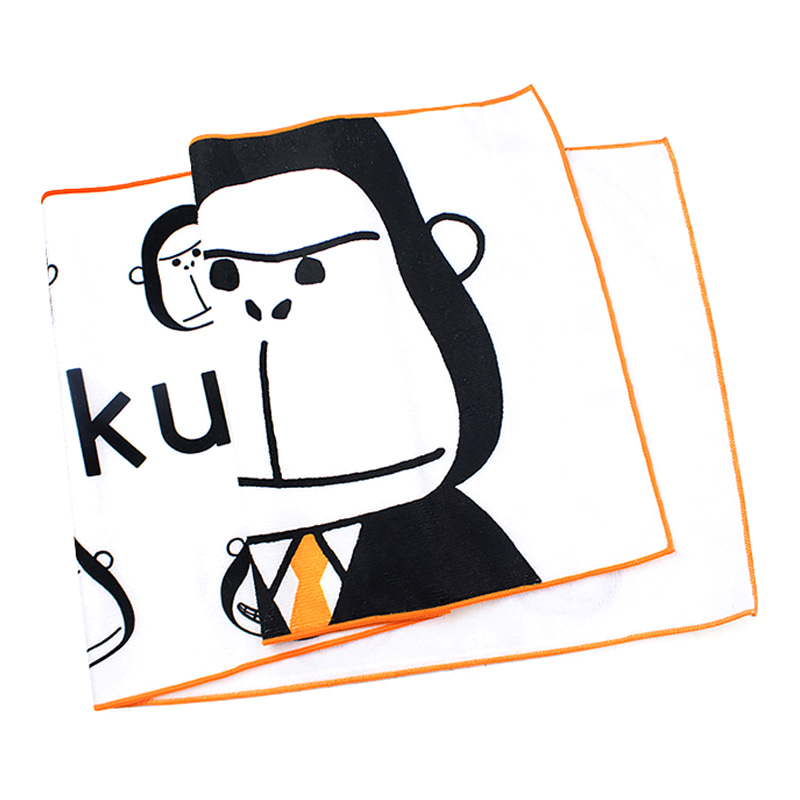
Demand for sports towel print customization is experiencing explosive growth. Previously, cooling sports towels were mostly solid colors, but modern consumers increasingly prefer personalized and customized products. The mature application of digital printing technology perfectly resolves the challenge of combining vibrant color expression with functional performance.
Technical Advantages of Digital Printing on Sports Towels
- Broad Fabric Compatibility: Digital direct and heat transfer printing technologies cover over 90% of common sports towel fabrics, including microfiber, cooling fabrics, and quick-dry polyester.
- Unlimited Pattern Freedom: Zero restrictions on pattern, color count, and size. Any complex design or gradient color can be precisely reproduced with resolution reaching 600-1200 DPI.
- Flexible Small-Batch MOQ: Minimum order quantities as low as 50 pieces, ideal for event merchandise and limited collaboration projects with short timelines.
- Color Fastness Compliance: Using reactive digital inks, dry rubbing color fastness reaches Grade 4-5, meeting the high-frequency washing demands of sports towels.
Currently, demand for customized sports towels is exceptionally strong across anime IP, game collaborations, sports events, theme parks, and brand anniversaries. Digital printing technology has elevated sports towels from "functional equipment" to "fashion items," significantly expanding their commercial boundaries.
Procurement Guide: Key Points for Selecting Outdoor Sports Towels and Evaluating Suppliers
Facing the vast array of sports towel products on the market, buyers need to establish a scientific evaluation system, systematically screening across four dimensions: material, functionality, certification, and production capacity.
Core Checklist for Outdoor Sports Towel Selection
- Material Selection: Prioritize microfiber or cooling technology fabrics to ensure quick-drying, lightweight, and high absorbency. GSM should be controlled between 200-350; excessive weight affects portability while insufficient weight compromises absorbency.
- Size and Portability: For outdoor sports, recommend 30×100cm to 40×90cm specifications that fold down to palm size. Prefer products with carrying pouches, clips, or strap designs.
- Antimicrobial Certification: Select products passing ISO 20743 or AATCC 100 antimicrobial testing. Silver ion or zinc ion treatments effectively inhibit bacterial growth and odor generation.
- UV Protection: For extended outdoor exposure scenarios, choose sports towels with UPF 50+ sun protection rating, combining sweat-wiping and skin protection functions.
- Supplier Capacity: Prioritize factories with annual output exceeding 5 million pieces, verifying digital printing lines and cooling fabric production capabilities. Single high-speed digital lines can produce approximately 1,500-2,500 pieces per day.
Additionally, buyers should request third-party testing reports from suppliers, with particular focus on formaldehyde content (<20mg/kg), color fastness (dry rubbing ≥Grade 4), and absorbency ratio (≥5x self weight). For custom orders, digital printing samples should be obtained within 72 hours, with color accuracy verified (ΔE value <2.0).
Industry Trends: Intelligence and Sustainability Driving in Tandem
Future competition in the sports towel industry will revolve around two directions: smart feature integration and green sustainable manufacturing. Leading enterprises have already begun forward-looking deployment in these areas.
Analysis of Two Major Trend Directions
Trend 1: Widespread Adoption of Eco-Friendly Recycled Materials
Recycled microfiber (rPET Microfiber) made from recycled PET bottles is rapidly gaining traction. Each standard-size sports towel consumes approximately 3-5 recycled plastic bottles, with carbon emissions 30-50% lower than conventional polyester. Some factories have achieved 80% production wastewater recycling and hold dual certifications from OEKO-TEX Standard 100 and GRS (Global Recycled Standard).
Trend 2: AI-Assisted Design and Flexible Manufacturing
AI-based pattern generation tools can compress sports towel design cycles from 3-5 days to hours. Intelligent scheduling systems automatically optimize production plans based on order priority, boosting equipment utilization to over 85% and on-time delivery rates for small-batch custom orders to over 95%. For event merchandise with extremely tight timelines, flexible manufacturing capability directly determines market competitiveness.
For buyers, selecting suppliers with deployed intelligent systems and environmental certifications means shorter sampling cycles, more transparent production tracking, and product positioning aligned with ESG trends. This is particularly critical when targeting European and American markets and sustainability-conscious consumer segments.
LATEST POST
Let’s create something amazing together
contact usFeatured Products

-
Phone
+86-0513-84186888/84523388
+86 180 1522 2999
-
Email
admin@bulanren.cn
-
Address
No. 128-8 Taihangshan Road, Rudong Economic Development Zone, Juegang Town, Nantong City, Jiangsu Province, China
- Media


